




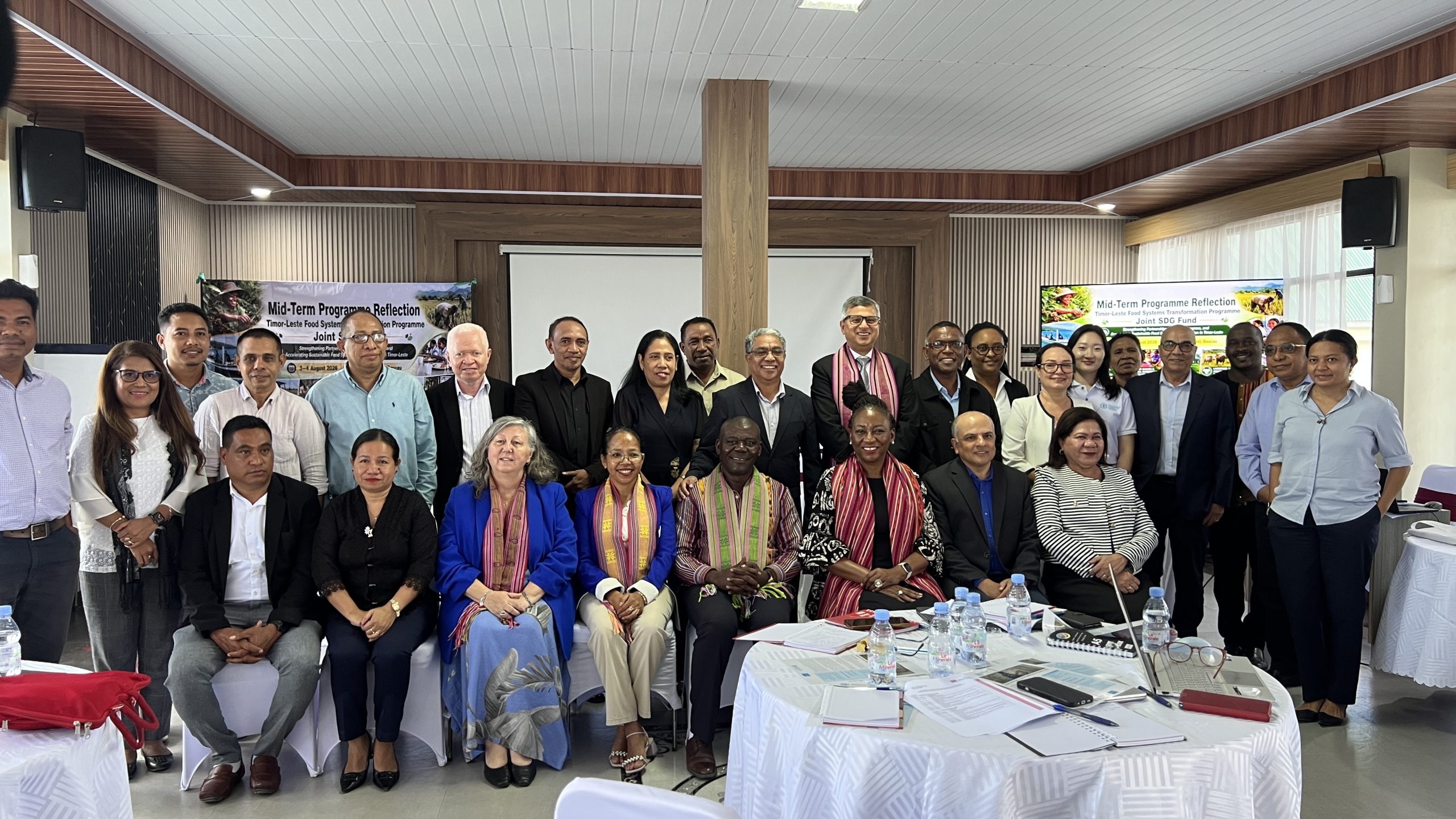
G-NEWS (BAUCAU) – The Government of Timor-Leste, the Food and Agriculture Organization of the United Nations (FAO) and the United Nations Children’s Fund (UNICEF), with financial support from the Joint SDG Fund, today opened a two-day Mid-Term Programme Reflection workshop to review progress and strengthen efforts towards more sustainable, inclusive and resilient food systems transformation in Timor-Leste.
The high-level opening session was attended by the Minister of Agriculture, Livestock, Fisheries and Forestry, H.E. Marcos da Cruz; United Nations Resident Coordinator, Ms. Funmi Balogun; FAO Representative to Indonesia and Timor-Leste, Mr. Rajendra Aryal; and UNICEF Representative, Ms. Patrizia DiGiovanni, alongside Adviser to the Vice Prime Minister, Mr. Christopher H. Samson; the Secretary of Municipal Social Affairs and Community Organization of Baucau, Ms. Maria Celestina Viegas.

The workshop, running through 4 August, brings together representatives from government institutions, municipalities, United Nations agencies and development partners involved in implementing the Timor-Leste Food Systems Transformation Programme.
The reflection provides an opportunity for stakeholders to review achievements and implementation challenges since the programme was launched in June 2025, share lessons learned and identify priorities for its final implementation period through June 2027.
In his opening remarks, Mr. Aryal welcomed participants and outlined the objectives of the two-day reflection. He highlighted the workshop as an opportunity for programme partners to jointly assess progress, reflect on implementation experiences and strengthen coordination for the remaining programme period.
Ms. Balogun emphasized that, “We must move beyond seeing this as simply another project. This programme represents a catalytic approach to transforming Timor-Leste’s food systems by strengthening governance, mobilizing further investment and bringing together partners around a shared national vision.”
Officially opening the workshop, H.E. Marcos da Cruz stressed that the impact of the programme should not be assessed through numerical results alone. “The true measure of success is not the number of reports we produce, but how we improve people’s lives through stronger value chains, higher incomes, more resilient food systems and greater opportunities for women and young people,” the Minister said.
Reviewing progress and setting priorities
The Joint SDG Fund supports the Timor-Leste Food Systems Transformation Programme, which FAO and UNICEF jointly implement in partnership with the Government of Timor-Leste.
The programme supports national efforts to strengthen food security, improve nutrition, promote climate-resilient agriculture, enhance livelihoods and build institutional capacity to accelerate progress towards the Sustainable Development Goals.
Since its launch, the programme has made progress across five result areas, including strengthening national food systems governance and coordination mechanisms, supporting the proposed National Food Systems Investment Partnership Platform and developing five priority Food Systems Investment Programmes.
The programme also supports the establishment of Municipal Agrifood Resource Centres and the proposed Food Systems Innovation Hub, as well as nutrition-sensitive interventions designed to contribute to healthier and more resilient food systems.
During the two-day workshop, FAO, UNICEF and programme partners are presenting progress against planned outputs, activities, targets and indicators. Participants are also discussing key achievements, implementation challenges, lessons learned and opportunities to strengthen multisectoral coordination and partnerships.
The discussions will help identify priority actions for the programme’s final year of implementation and areas requiring further technical, institutional and leadership support.
Strengthening investment and sustainability
A major focus of the workshop is the presentation and discussion of five priority Food Systems Investment Programmes developed under the programme.
These investment programmes aim to strengthen government ownership, improve investment readiness, attract strategic partnerships and mobilize resources for long-term food systems transformation beyond the duration of the Joint Programme.
Participants will provide technical and strategic feedback to strengthen the investment programmes and improve their potential for future implementation and financing.
The workshop will also address sustainability, institutional ownership and transition planning. Discussions will consider how to sustain and institutionalize key programme platforms and innovations, including the National Food Systems Investment Partnership Platform, Municipal Agrifood Resource Centres, the Food Systems Innovation Hub and nutrition-related education activities.
By the end of the reflection, participants are expected to develop a shared roadmap from August 2026 to June 2027, outlining priority actions, institutional responsibilities and coordination mechanisms for the programme’s final implementation period.
Through the programme, FAO and UNICEF remain committed to supporting the Government of Timor-Leste in advancing food systems that improve nutrition, strengthen livelihoods and create greater opportunities for all, particularly women and children.


 loading="lazy" />